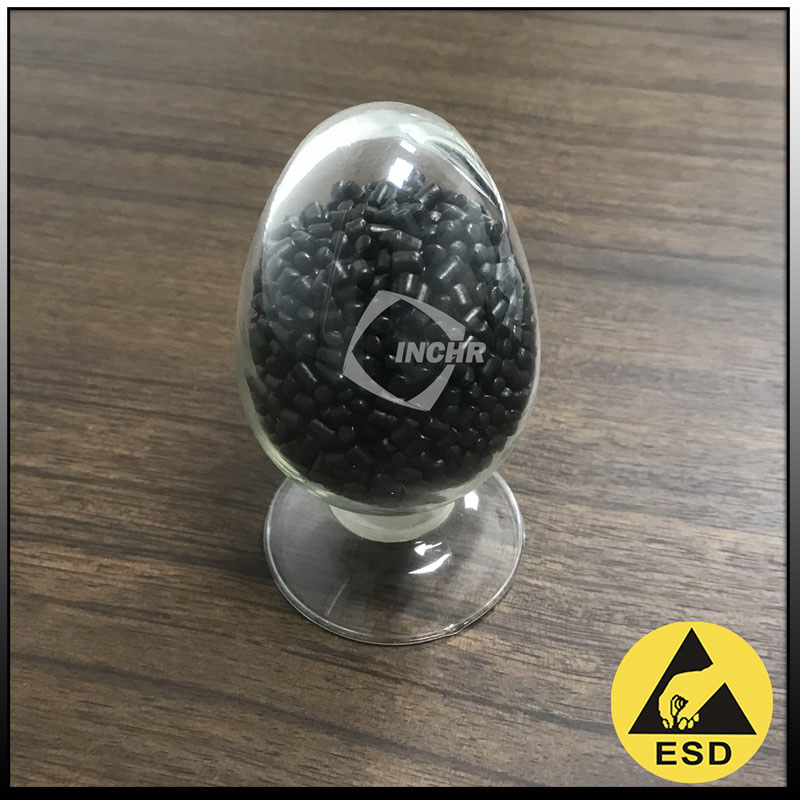
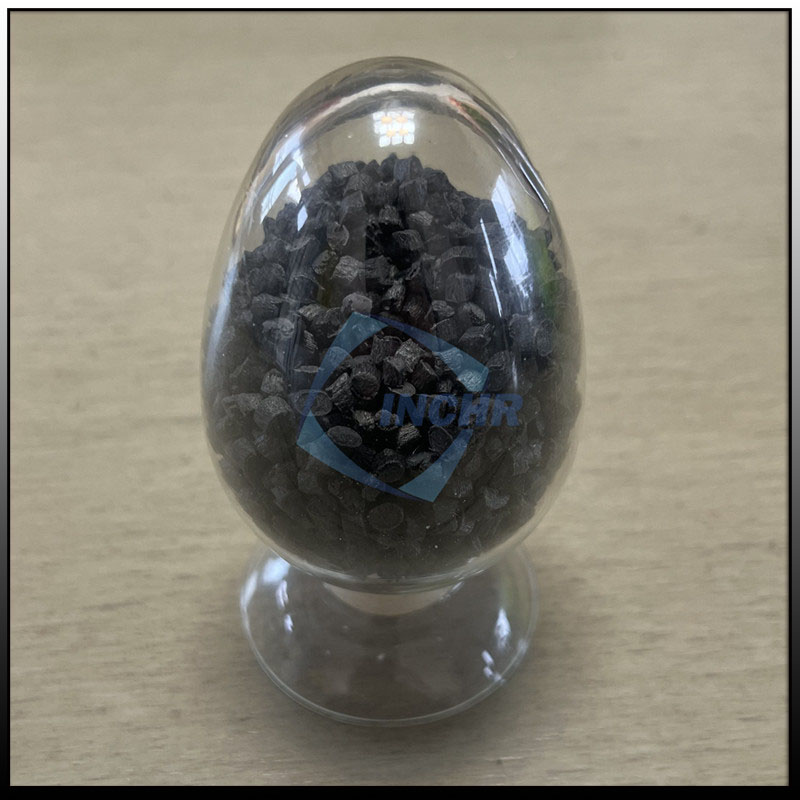
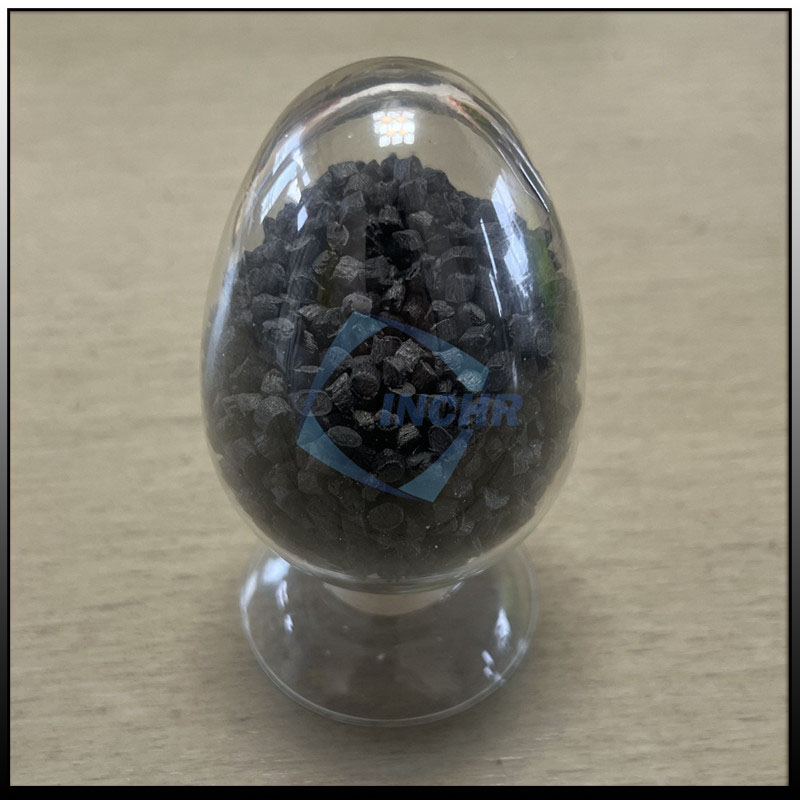
Conductive masterbatch is the practical way to turn an insulating plastic into an ESD-safe one: a polymer carrier loaded with conductive carbon black, added at low let-down ratios during molding or extrusion. Instead of replacing your entire resin inventory, you compound the conductivity you need into the parts you already produce. This guide covers how conductive masterbatch works, where it solves real problems, how to choose the loading, and how to process it without losing the conductive network.
What Conductive Masterbatch Actually Is
A conductive masterbatch is a concentrated compound: a base resin — PP, PE, ABS, or PA — densely loaded with conductive carbon black, usually between 25% and 40% by weight. The processor adds it to virgin or recycled polymer at a low ratio, typically 5% to 20%, and the masterbatch’s carrier melts and disperses uniformly during the process.
Why take this route instead of buying pre-compounded conductive material? Three reasons:
- Inventory flexibility — one conductive masterbatch converts multiple base resins and grades on demand.
- Lower cost per part — you pay for conductivity only where it is needed.
- Process freedom — adjust the let-down ratio to hit the surface resistivity target, instead of accepting a fixed grade.
The trade-off is discipline: because the masterbatch is a concentrate, mixing and drying errors multiply, and the final resistivity depends on whether the carbon black network survives the process.
The Physics: How Carbon Black Creates a Conductive Path
Unfilled polymers are insulators with surface resistivity above 10^12 ohm/sq. Carbon black changes that through percolation: when enough carbon black particles touch or sit close enough for electrons to hop between them, they form a conductive network through the plastic. Below that threshold the material stays insulating; a few percent more filler and resistivity can fall by many orders of magnitude.
This is why dosing matters so much with conductive masterbatch:
- Above the percolation threshold — surface resistivity drops into the 10^3–10^6 ohm/sq range that qualifies as ESD-safe material.
- Below it — the part looks identical but remains electrically insulating, failing static-control requirements.
- At the knee of the curve — resistivity swings sharply with small changes in loading, so reproducibility depends on accurate dosing.
The network is also fragile in processing: over-shear breaks carbon black agglomerates, under-dispersion leaves dead spots, and crystalline or flow-oriented morphologies can redistribute the filler unevenly. Keep this mechanism in mind for every processing decision below.
Where Conductive Masterbatch Earns Its Place
The value shows up in parts whose job is to prevent static damage or static ignition. The highest-volume applications:
- Electronic packaging — trays, tubes, and tote boxes that carry PCBs, connectors, and sensitive components without generating or holding charge.
- Cleanroom equipment — chair components, shelving, and fixtures that must not attract particles electrostatically.
- Automotive fuel systems — filter housings, brackets, and caps where static discharge near fuel is a safety hazard.
- Explosive-environment tools — housings and handles for mining, paint, and chemical industries, where ignition must be excluded.
- Industrial handling — bins, dunnage, and work surfaces that protect ESD-sensitive assemblies on line.
In every case the plastic part stays light, corrosion-free and formable, while the carbon network provides a controlled, drainable resistance path. For thin-wall housings that also need stiffness rather than just static protection, compare.
Choosing the Right Carbon Black Loading
The loading determines both resistivity and mechanical properties, so selection starts from the target, not from habit:
- Define the resistivity target — anti-static league (about 10^6–10^9 ohm/sq) or conductive league (10^3–10^6 ohm/sq) dictate different carbon black types and loadings.
- Match the carrier — the masterbatch carrier must be compatible with your base resin to avoid haze, weld lines, or phase separation.
- Pick the carbon black grade — acetylene black and super-conductive blacks reach their percolation threshold at lower loadings than standard furnace black, at a price premium.
- Budget the mechanical impact — carbon black loading reduces impact strength and can increase melt viscosity; balance conductivity against ductility.
- Validate on real parts — resistivity measured on molded coupons differs from parts with weld lines, gates, and varying wall thickness.
Loading is a lever, not a fixed value: the same masterbatch can be dosed at 8% for a static-dissipative floor tile and at 15% for a conductive tray. Where the application demands higher stiffness, fatigue life, or wear resistance alongside conductivity.
Processing: Protecting the Conductive Network
Most conductive masterbatch failures are processing failures. The short version of the rules:
- Dry the masterbatch and the blend — moisture degrades the matrix and can shift resistivity, especially in nylon or PET carriers.
- Keep shear moderate — excessive screw speed or back pressure breaks carbon black structures and raises resistivity; reduce shear before changing dosing.
- Watch the melt temperature — stay inside the recommended window; overheating degrades the carrier and can also compact the carbon network unevenly.
- Dose accurately — use gravimetric blenders; volumetric drift of a few percent can push resistivity across the acceptance boundary.
- Recycle with care — regrind contains orientated and possibly broken carbon networks; blend ratios must be recomputed, not reused blindly.
The same principle applies to every process: injection molding, sheet extrusion, blow molding, and film. Verify with an in-line or batch resistivity check after first-setup parts, not just on the raw masterbatch.
Why Consistency Is the Real Product
INCHR has compounded ESD and performance plastics in Dongguan since 2012, producing permanent antistatic additives, conductive compounds, antistatic compounds, carbon fiber reinforced compounds, ESD masterbatches, and graphene-reinforced plastics. Conductive masterbatch is compounded in twin-screw granulation units under an ISO9001:2008 quality system, with professional ESD testing equipment on site — so resistivity targets are checked, not assumed. A research partnership with East China University of Science and Technology backs the formulation work.
That consistency is the entire point of a masterbatch: a predictable let-down ratio, a reproducible resistivity window, and conductivity that survives molding. When you evaluate a supplier, ask for batch-to-batch resistivity records, not just a data sheet. Contact INCHR with your conductivity requirements.