Why Consistency Matters More Than Conductivity Alone
In plastic manufacturing, achieving a target electrical resistance in one sample is only part of the challenge. The greater difficulty is maintaining that performance across different production batches, molding cycles, and finished components.
This is why selecting a suitable conductive masterbatch requires more than comparing electrical resistance values. Manufacturers must also consider resin compatibility, filler dispersion, processing stability, and the consistency of the final product.
A formulation that performs well in a laboratory trial may behave differently during continuous extrusion or injection molding. Understanding the factors behind this difference helps manufacturers reduce production risks and improve product reliability.

1. Conductive Filler Selection Determines the Starting Point
Conductive masterbatch typically combines a polymer carrier with conductive fillers and functional additives. Different fillers create different performance and processing characteristics.
| Conductive filler | Main characteristics | Considerations |
|---|---|---|
| Carbon black | Widely used and cost-effective | Loading and dispersion can influence mechanical properties |
| Carbon nanotubes (CNT) | Can form conductive networks at relatively low concentrations | Requires appropriate dispersion and formulation control |
| Carbon fiber | Provides electrical pathways and may improve stiffness | Fiber length and orientation can affect final properties |
| Graphene-based materials | Offers potential for specialized conductive formulations | Performance depends on material quality and dispersion |
The best filler depends on the intended application. For example, electronic packaging may prioritize controlled electrical resistance, while industrial components may also require mechanical strength and dimensional stability.
2. Resin Compatibility Should Be Evaluated Before Production
A conductive filler cannot deliver reliable results if the masterbatch carrier is poorly matched to the base polymer.
Common plastic matrices include polypropylene (PP), polyethylene (PE), polystyrene (PS), ABS, polycarbonate (PC), and nylon. Each resin has different melting behavior, flow characteristics, and processing requirements.
When selecting a conductive masterbatch, manufacturers should confirm:
- Whether the carrier resin is compatible with the target polymer.
- Whether the recommended processing temperature matches the production process.
- Whether the formulation can maintain suitable melt flow.
- Whether the final material meets mechanical and appearance requirements.
For instance, a formulation developed for PP should not automatically be assumed suitable for PC or ABS. Resin-specific testing is necessary before changing the material system.
3. Dispersion Quality Influences Batch-to-Batch Stability
Uniform filler dispersion is one of the most important factors in conductive plastic production.
If conductive particles are distributed unevenly, some areas of a molded component may have different electrical properties from others. Poor dispersion can also contribute to surface defects, inconsistent appearance, and changes in mechanical performance.
Several production factors influence dispersion:
Compounding conditions: Screw configuration, mixing intensity, temperature, and residence time can affect how fillers are distributed throughout the polymer.
Additive formulation: Dispersants, coupling agents, and other additives may be used to improve compatibility and processing, depending on the material system.
Material preparation: Moisture control and consistent raw-material feeding are important, particularly when processing moisture-sensitive engineering plastics.
A stable compounding process should be developed for each formulation rather than relying on one universal processing setting.
4. Dosage Must Be Confirmed Through Application Testing
Adding more conductive masterbatch does not always produce the best overall result. Excessive loading may affect melt flow, surface finish, toughness, or production efficiency.
The appropriate addition ratio depends on the filler type, carrier resin, base polymer, and required electrical performance.
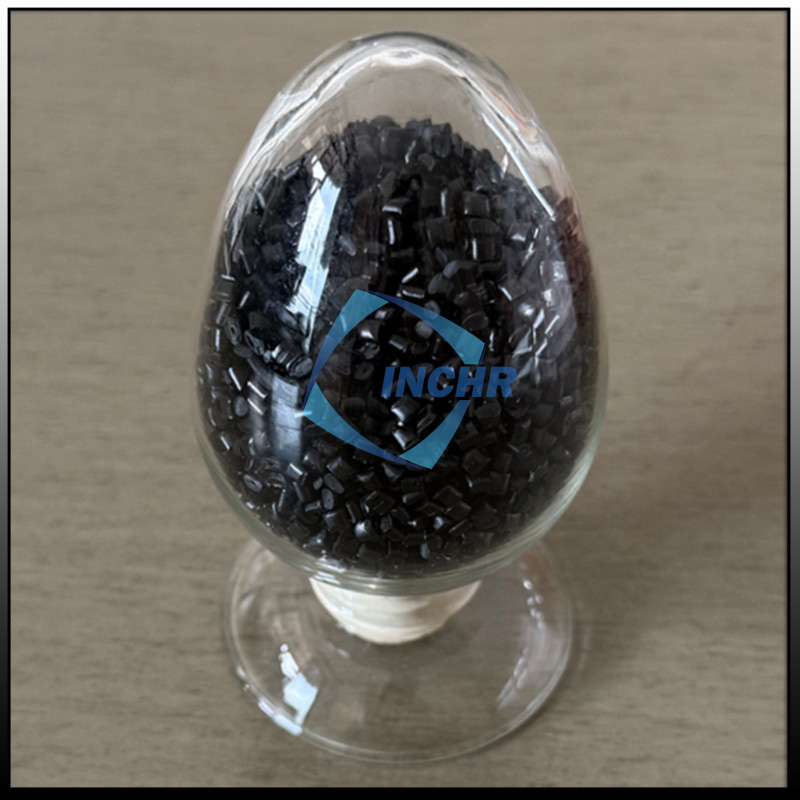
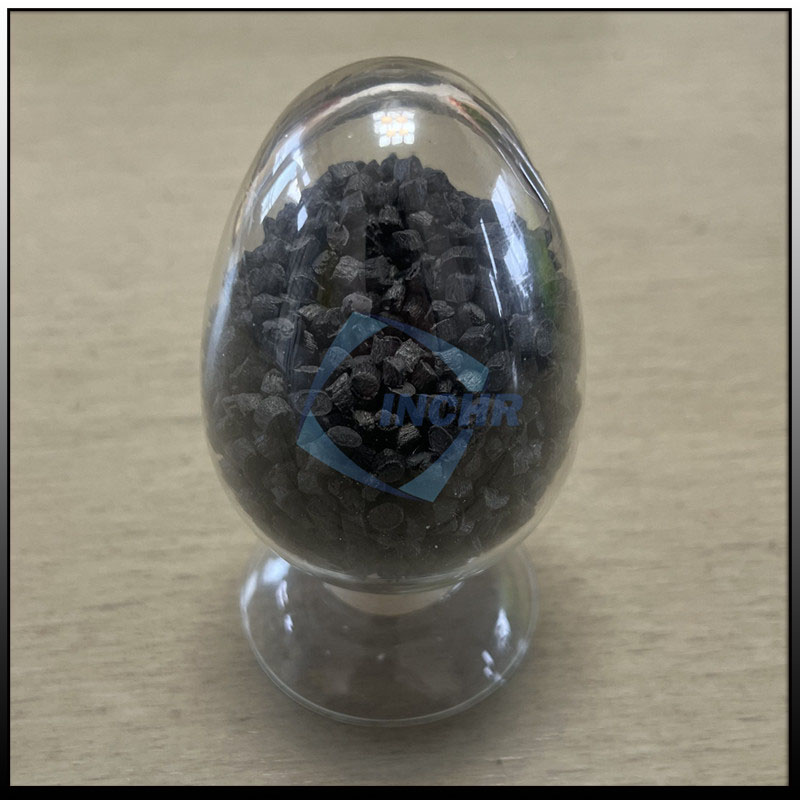
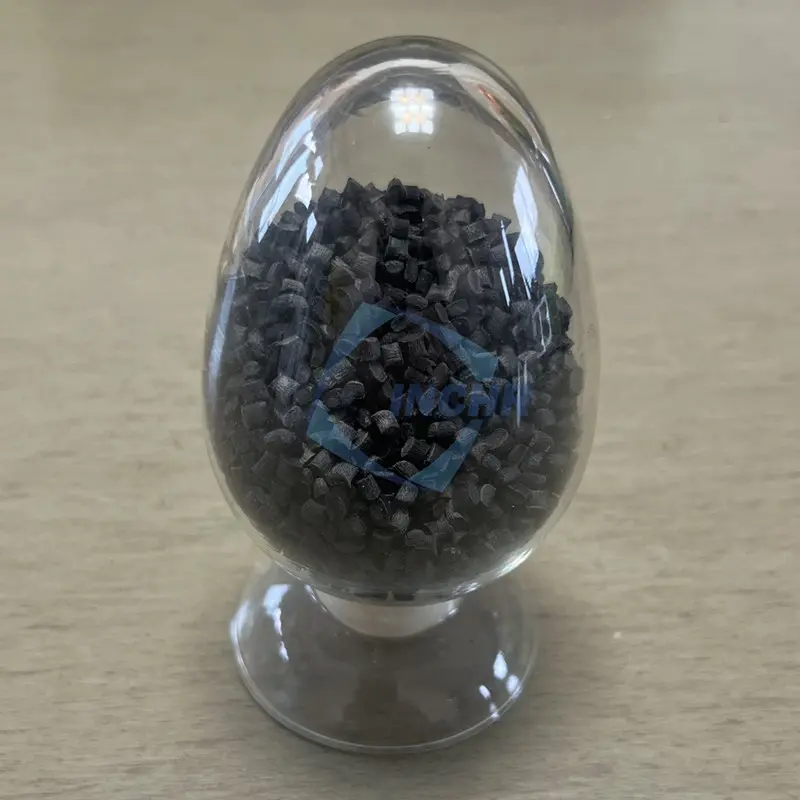
For example, INCHR’s conductive masterbatch product information lists different formulations for several polymer systems, with application-specific dosage and resistance ranges. Its general conductive masterbatch range includes carbon black, carbon nanotubes, and stainless steel fiber formulations.
| Evaluation item | What manufacturers should verify |
|---|---|
| Addition ratio | Recommended dosage for the selected resin |
| Surface resistance | Whether the finished part meets the target |
| Volume resistivity | Whether internal electrical performance is suitable |
| Melt flow | Whether the material can be processed consistently |
| Mechanical properties | Whether strength and toughness remain acceptable |
| Appearance | Whether surface defects or visible filler marks occur |
The dosage should be finalized through trial production and testing of actual molded or extruded samples.
Review the technical details of INCHR’s conductive masterbatch for plastics.
5. Build a Practical Quality-Control Plan
A reliable conductive plastic product requires more than a single resistance measurement. Manufacturers should establish a quality-control plan that evaluates both incoming materials and finished components.
A practical process may include:
- Incoming material inspection: Confirm resin type, material identification, packaging condition, and relevant supplier documentation.
- Processing verification: Record drying conditions, feeding ratios, extrusion or molding temperatures, and other critical parameters.
- Electrical testing: Measure surface resistance or volume resistivity using a method appropriate to the material and application.
- Mechanical evaluation: Check relevant properties such as tensile strength, impact resistance, or dimensional stability.
- Batch comparison: Compare results across production runs to identify unwanted variations.
For electrical testing, manufacturers can consult relevant methods such as ASTM D257, while selecting the specific procedure according to the specimen and application.
ASTM D257 – Standard Test Methods for DC Resistance or Conductance of Insulating Materials.
6. Match the Material to the Finished Product
The right conductive masterbatch is determined by the conditions under which the finished product will operate.
| Application | Key material considerations |
|---|---|
| ESD packaging sheets and trays | Electrical resistance, surface quality, and forming stability |
| Electronic component housings | Resin compatibility, dimensional accuracy, and static control |
| Industrial plastic components | Electrical performance, mechanical strength, and durability |
| Extruded plastic films | Uniform dispersion, film appearance, and processing stability |
Manufacturers should define the required electrical performance before choosing a grade. Antistatic, static-dissipative, and conductive materials serve different purposes and should not be treated as interchangeable.
Learn more about processing considerations for conductive masterbatch in ESD plastics.
Why Work with INCHR?
Established in Dongguan, China, in 2012, INCHR specializes in ESD plastic materials and modified polymer solutions. Its product portfolio includes conductive compounds, antistatic compounds, permanent antistatic additives, carbon fiber reinforced compounds, ESD masterbatches, and other functional plastics.
Supported by an R&D team with technical cooperation from East China University of Science and Technology, INCHR develops material solutions for different polymer systems and application requirements.
The company has polymerization equipment, twin-screw granulation units, single-screw processing equipment, and professional ESD testing equipment. These capabilities support formulation development, material processing, and electrical performance evaluation.
For manufacturers evaluating a new conductive masterbatch, it is useful to provide the target resin, processing method, required resistance range, and finished-product application when discussing material selection.
Explore INCHR’s ESD and modified plastic products or contact the technical team to discuss your project requirements.
Frequently Asked Questions
1. What is conductive masterbatch?
Conductive masterbatch is a concentrated polymer-based material containing conductive fillers. It is added to a compatible base resin to provide controlled electrical properties in finished plastic products.
2. Which fillers are commonly used in conductive masterbatch?
Common fillers include carbon black, carbon nanotubes, and carbon fiber. Some specialized formulations also use graphene-based materials or stainless steel fibers.
3. Can conductive masterbatch be used with PP, PE, ABS, and PC?
Yes. Different formulations are available for different polymer systems. However, carrier compatibility, processing temperature, and final electrical performance should be confirmed for each resin.
4. How do manufacturers determine the correct addition ratio?
The addition ratio depends on the conductive filler, polymer matrix, target resistance, and processing method. Manufacturers should conduct formulation trials and test finished samples before mass production.
5. Does a higher conductive masterbatch dosage always improve performance?
Not necessarily. Increasing the dosage may affect mechanical properties, melt flow, appearance, and production cost. The optimal ratio should balance electrical performance with other product requirements.
6. How can conductive masterbatch performance be tested?
Common evaluation methods include surface resistance and volume resistivity testing. Mechanical properties, appearance, and processing behavior should also be checked when relevant to the application.
7. What information should I provide when requesting a conductive masterbatch?
Provide the base resin, manufacturing process, target electrical performance, intended application, and any important mechanical or appearance requirements. This information helps the supplier assess a suitable formulation.
Consistent conductive plastic production starts with the right formulation and continues through controlled processing and finished-product testing. By evaluating resin compatibility, filler dispersion, dosage, and electrical performance together, manufacturers can select a conductive masterbatch that is better suited to stable, repeatable production.