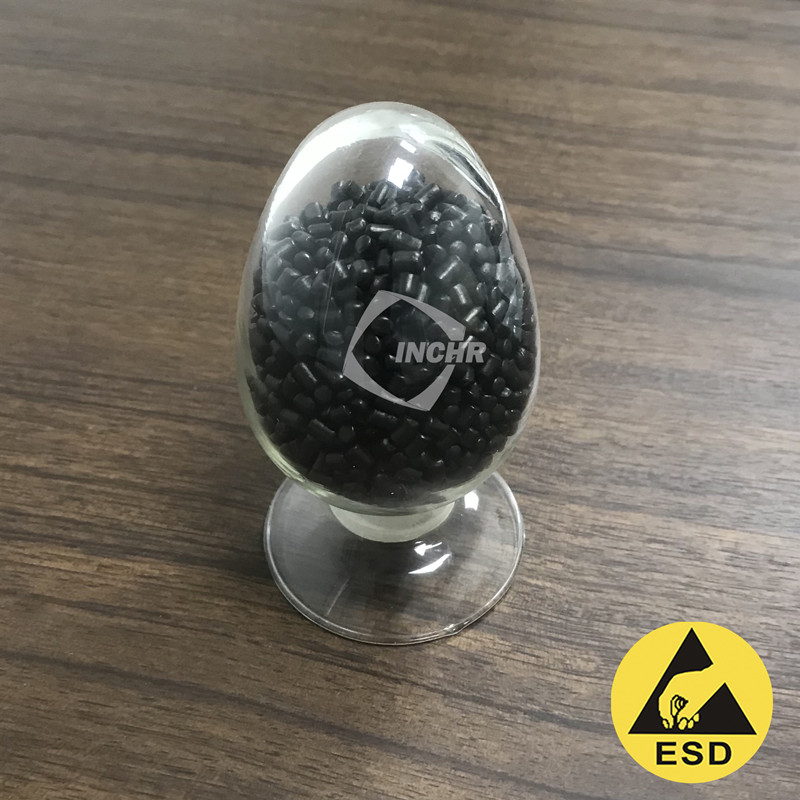
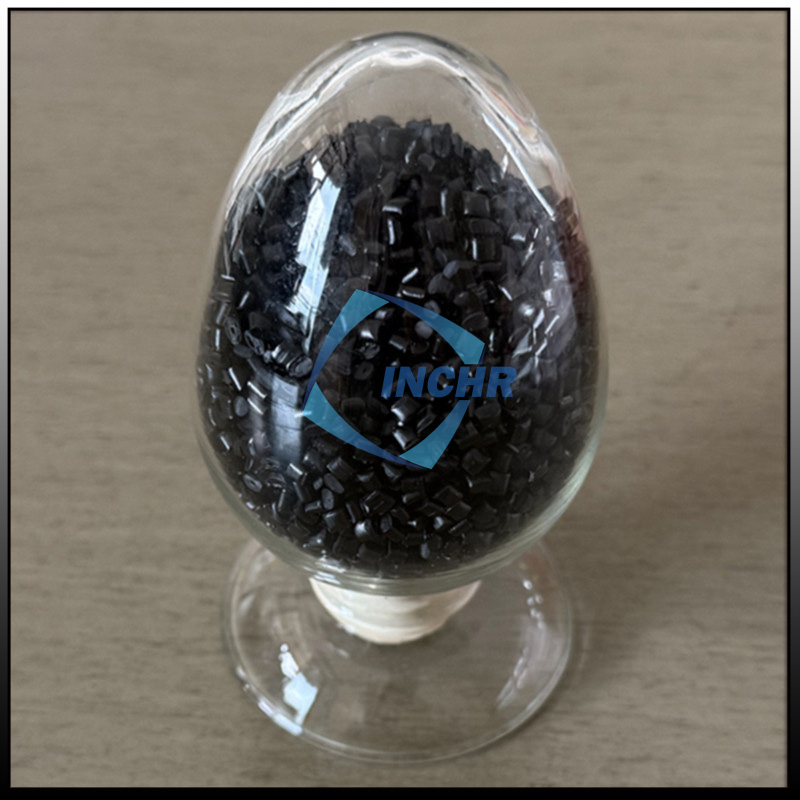
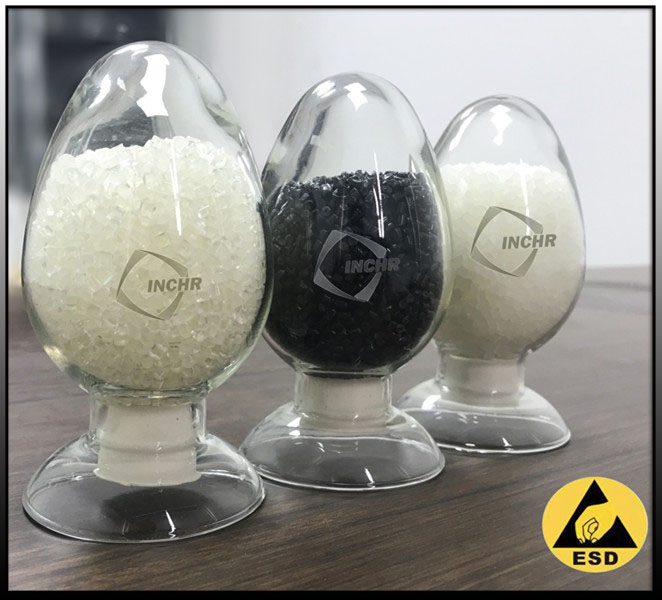
Conductive masterbatch is a concentrated pelletized additive that turns a standard thermoplastic into an electrically conductive compound. Adding a controlled dosage of these pellets to the base resin before injection molding, extrusion, or film blowing gives parts the ability to bleed static charge, protect sensitive electronics, and meet ESD requirements for the full service life of the component. Because conductive masterbatch is delivered as clean pellets rather than loose conductive powders, processors get consistent dispersion, safe handling, and repeatable results. This guide explains how these additives work, the resistance ranges you should specify, how to select the right grade, and where INCHR’s ESD plastics expertise fits in.
What Is Conductive Masterbatch?
Conductive masterbatch is a carrier resin loaded with a high concentration of conductive filler. The processor adds it to a base polymer at a defined let-down ratio, and the compounded material delivers target resistivity after molding. The most common conductive fillers include:
- Conductive carbon black — the most cost-effective option, compatible with a broad range of resins, and capable of reaching the conductive band in both surface and volume resistivity.
- Carbon fiber — adds conductivity plus strength and stiffness, making it the choice for structural ESD parts.
- Graphene — achieves conductivity at very low loading, preserving the base resin’s mechanical properties.
- Carbon nanotubes and metal powders — used where extremely low resistivity or special functional performance is required.
The choice of filler and its dispersion quality decide the finished part’s resistance. This is why a conductive masterbatch from an experienced compounder behaves consistently, while a generic additive may fail after the first production run.
How Conductive Masterbatch Works
Conductive masterbatch works through a principle known as the percolation threshold. When filler concentration is low, particles stay separated and the plastic remains insulating. As loading crosses a critical level, particles begin to touch and form continuous conductive pathways; resistivity then drops sharply, and further small increases in loading cause a steep, predictable fall in resistance. Above the optimum window, extra filler no longer helps: it raises cost, reduces impact strength, and may affect melt flow.
Because the transition is sharp, processing repeatability matters. Twin-screw compounding, as applied by INCHR, ensures the filler is evenly dispersed and the conductive network forms reliably from batch to batch. Uniform dispersion also keeps molded-in stress low and part-to-part resistance consistent.
Resistance Ranges You Need to Know
Resistance is expressed either as surface resistivity (ohms per square, Ω/sq) or volume resistivity (Ω·cm). The ranges that matter in practice follow the ESD Association definitions: [External Link: ESDA official definitions (esda.org)]
- Conductive — surface resistivity below 1 × 10^4 Ω/sq. Parts in this band dissipate charge almost instantly; typical uses include fuel-system components and explosive-area equipment.
- Static dissipative — roughly 1 × 10^4 to 1 × 10^11 Ω/sq. This is the ESD-safe working range for trays, tote boxes, and packaging that must release charge slowly and safely.
- Insulative — above 1 × 10^11 Ω/sq. Standard unfilled plastics fall here and are the reason ESD control is needed at all.
Conductive masterbatch lets you target any of these zones by controlling filler type, loading, and carrier design — without switching the base resin or adding a secondary process step.
How to Choose the Right Conductive Masterbatch
Every application needs a slightly different balance. Work through this checklist to define the specification before talking to a supplier:
- Base resin — the masterbatch carrier must be compatible with the polymer you actually use: PE, PP, ABS, PC, PA, POM, TPU, and others each need a matched carrier.
- Target resistance — decide the conductivity band from the table above: fully conductive, static dissipative, or a point in between.
- Filler type — choose carbon black for cost efficiency, carbon fiber for structural needs, or graphene where low loading and preserved mechanics matter.
- Processing method — injection molding, profile extrusion, and film blowing impose different limits on filler loading and melt flow.
- End-use environment — humidity, temperature, chemical exposure, and mechanical abuse all affect long-term ESD performance.
- Compliance — confirm RoHS, REACH, food-contact, and UL requirements up front so the final part qualifies for its market.
A good supplier documents the recommended let-down ratio and provides test data at that ratio, so your molder can reproduce target resistivity in production.
Where Conductive Masterbatch Is Used
Conductive masterbatch appears wherever static charge threatens product quality, safety, or performance:
- Electronics packaging — IC trays, carrier tapes, tote boxes, and molded bins that must never discharge into sensitive components.
- Automotive — fuel-system components, sensor housings, and connectors that require conductive performance in demanding environments.
- Explosive atmospheres — containers, scoops, and handling equipment used where a static spark could ignite dust or vapor.
- Cleanrooms — fixtures, cassettes, and furniture that must remain charge-free and easy to clean.
- Cables and connectors — conductive layers for power and data cabling that need defined resistivity.
- EMI-management parts — graphene or carbon-fiber-loaded housings that combine conductivity with mechanical strength.
Testing and Standards
Conductive masterbatch and the parts made from it are verified with standard measurement methods:
- ASTM D257 — standard test for surface and volume resistivity of insulating and conductive materials.
- ESD Association standards — established procedures for measuring the resistance of ESD-protective packaging and materials.
- In-house verification — professional ESD testing equipment confirms conductivity before shipment; finished parts can be spot-checked with surface resistance meters during production.
Specifying the test method in the purchase order prevents disputes: the same part can rate differently under different humidity and voltage conditions, so the standard, electrode configuration, and conditioning must be agreed with the supplier.
Why Choose INCHR for Conductive Masterbatch
INCHR was founded in Dongguan, China in 2012 and specializes in ESD plastics. The company’s product line covers permanent antistatic additives, conductive compounds, antistatic compounds, carbon fiber reinforced compounds, ESD masterbatches, and graphene-reinforced plastics — so these ESD masterbatch products are built on a deep, ESD-specific foundation rather than a general compounding side line.
- Technical depth — the R&D team works with East China University of Science and Technology, combining academic research with industrial know-how.
- Production capability — advanced polymerization equipment, twin-screw granulation units, and single-screw dyeing workshops support precise, repeatable compounding.
- Quality assurance — professional ESD testing equipment and ISO9001:2008 certification back every batch from raw material to dispatch.
- End-to-end support — INCHR helps define the specification, selects the right filler and carrier, and validates the result on your resin and process.
Conductive masterbatch is not a one-size-fits-all product; it is an engineered solution. Choosing the right partner determines whether the parts you ship carry the exact resistivity you promised. Contact INCHR to discuss your conductive masterbatch specification