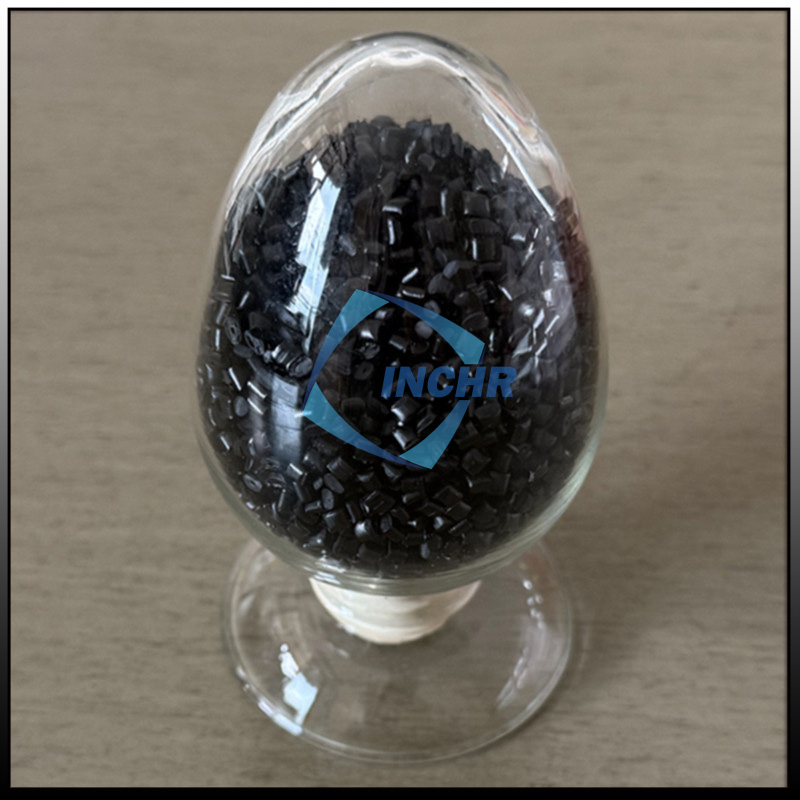
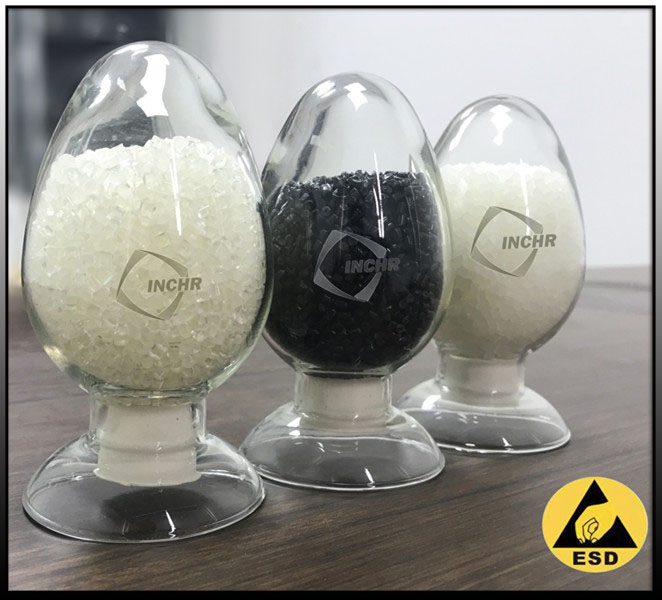
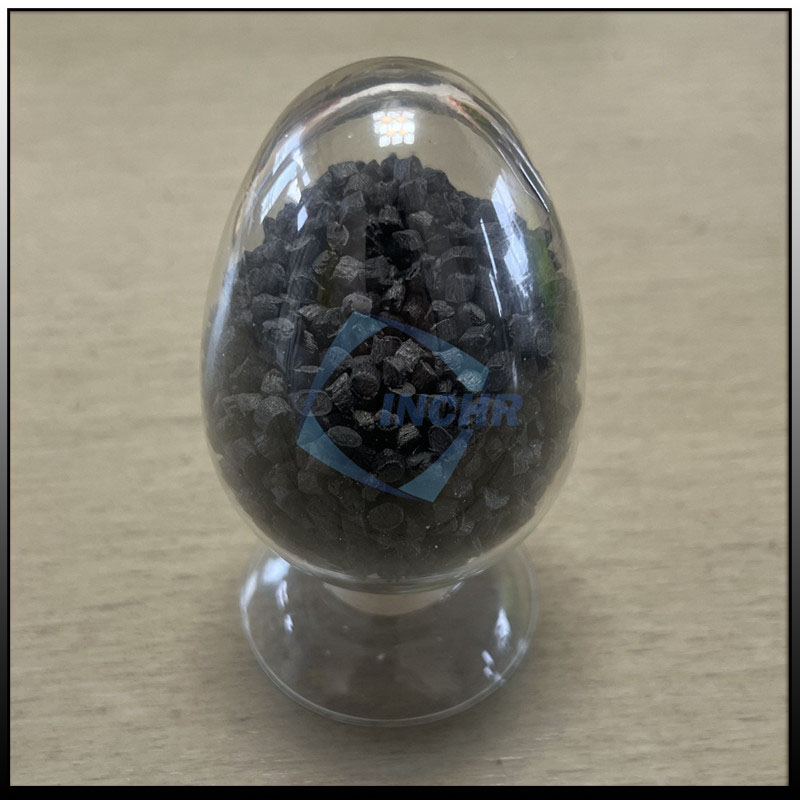
Open a plastics catalog and you will find dozens of carbon fiber grades, each carrying more numbers than anyone can remember. This page is the short version: the five specifications that decide whether a part works, what the datasheet does not print, and the three questions that keep your parts out of rework. If you specify structural plastics for electronics, automotive, or consumer products, save this sheet.
The One-Page Spec Sheet
The table below compares a typical short-carbon-fiber polycarbonate series with unfilled PC and die-cast aluminum. Treat the values as reference points, not promises, because every supplier compounds differently.
| Property | Unfilled PC | PC/CF 10% | PC/CF 30% | Die-Cast Al |
|---|---|---|---|---|
| Tensile modulus (GPa) | ~2.4 | ~5.5 | ~13–15 | ~70 |
| Density (g/cm³) | 1.20 | 1.24 | 1.35 | 2.70 |
| CTE (×10⁻⁶/K) | ~70 | ~40 | ~20–25 | ~23 |
| Elongation at break | ~100% | ~6–8% | ~2–3% | ~2–5% |
| Weight vs. same aluminum part | −55% | −55% | −50% | baseline |
Three readings matter here. First, modulus climbs steeply between 10 and 30 percent fiber, so do not pay for the top grade unless a load case demands it. Second, elongation collapses: a PC/CF 30 part bends less but snaps more suddenly than unfilled PC, which changes how you design snap-fits and impact zones. Third, density stays close to 1.3, which is why a PC/CF part can beat aluminum on weight even when its stiffness is lower.
What the Datasheet Does Not Print
Manufacturers publish modulus and impact numbers, but the properties that break parts are the ones nobody prints:
- Anisotropy: fibers align with melt flow, so stiffness along the flow direction can be 30 percent higher than across it. A center-gated round part behaves differently from a side-gated long beam.
- Fiber read-through: carbon fibers roughen the molded surface, producing a visible “orange peel” texture that spoils cosmetic housings. Paint, texture, or a surface-modified grade is the usual fix.
- Moisture discipline: polycarbonate absorbs water, and water in the melt turns fibers into steam bubbles. Dry PC/CF pellets at around 120 °C for three to four hours before molding, every time.
- Notched vs. unnotched impact: the notch sensitivity of fiber-filled PC surprises engineers who validated parts only in unnotched samples.
The Cost Reality Check
Carbon fiber compounds cost roughly three to five times more than unfilled PC, and each 5 percent of added fiber moves the price upward. The economical path is therefore not the stiffest grade but the thinnest wall that survives. Compare two options before quoting: a 2.5-mm PC/CF 20 housing against a 3.0-mm aluminum-wall substitute, and count labor, tooling, and finishing. Regrind deserves its own caution: every re-pass shortens fibers, and shorter fibers deliver less reinforcement, so cap regrind content and document the ratio.
The Processing Checklist
- Dry: 120 °C, three to four hours, verified moisture level before molding.
- Mold temperature: controlled 80–120 °C for surface quality and fiber orientation at the skin.
- Injection speed: fast enough to fill thin walls, slow enough to avoid fiber burn marks and shear degradation.
- Gate and runner: short and direct; every restriction shears fibers, every hesitation creates weak knit lines.
- Tool protection: hardened steel or plated wear zones, because fibers abrade conventional tool steel.
The ESD and EMI Bonus
Because carbon fibers conduct electricity, a properly formulated PC/CF grade does double duty: it bleeds static charge and attenuates electromagnetic interference, with surface resistivity typically landing in the 10³–10⁶ ohm/sq range. For electronic enclosures, ESD-safe fixtures, and automotive housings near sensitive modules, one material can replace a structural plastic plus a conductive coating or overmold step. If your target is simply static dissipation rather than shielding, an antistatic compound or masterbatch may cost less while meeting the requirement.
Verify the Supplier
Composite performance lives in dispersion, and dispersion lives in compounding. Ask any candidate supplier three questions. Do they compound in-house on twin-screw equipment, or do they blend on one pass and hope? Do they test resistivity, modulus, and moisture on every lot, or only on certificates from years ago? Will they hand over a full material data sheet and reference samples before you commit tooling?
INCHR, founded in Dongguan in 2012, compounds carbon fiber reinforced polycarbonate in-house, verifies every batch with professional ESD and mechanical testing equipment, and operates under ISO9001:2008 certification. Its R&D team works with East China University of Science and Technology, which keeps the formulations under continuous review rather than frozen in a decade-old recipe.
Contact INCHR — request a PC/CF sample and full material data sheet.
A Simple Decision Tree
Use these five if-then rules at the start of every project:
- If the part carries load and weight matters, choose PC/CF and design ribs instead of thicker walls.
- If the part must absorb repeated impact, step down the fiber content or move to unfilled PC with a toughener.
- If EMI or static control is required, confirm the ESD-grade formulation before quoting.
- If the budget is fixed and grams are not, evaluate glass fiber PC first; it is cheaper, though heavier and less stiff.
- If you do not know their per-lot test data, choose a different supplier.
Last Line
Every datasheet is a promise about pellets; only molding trials tell the truth about parts. Order a sample, dry it properly, mold your actual geometry, and measure the real numbers before you commit to production. That discipline, not the catalog, is what makes carbon fiber polycarbonate pay off.