A tiny electrostatic discharge can erase a memory chip, ignite solvent vapor, or jam an automated packaging line within milliseconds. For manufacturers in electronics, automotive, and clean-room industries, static control is not a luxury but a design requirement. ESD plastics solve this problem at the material level: instead of adding clamps, sprays, or ionizers to the production environment, the plastic part itself safely dissipates static charge. This guide explains what ESD plastics are, the main types available, where they are used, and how to select the right static-control material for your application.
What Are ESD Plastics?
ESD plastics, short for electrostatic discharge plastics, are polymer materials modified with conductive or antistatic additives so that surface resistivity falls far below the insulative level of standard plastics. While a typical engineering plastic has surface resistivity above 10¹² ohm/sq, an ESD plastic is formulated to land between 10³ and 10⁹ ohm/sq, where static charges dissipate quickly and safely instead of accumulating.
Because the conductive function is built into the resin itself, ESD plastics protect components throughout the whole product lifetime. They do not rely on coatings that abrade, humidity that changes daily, or maintenance schedules that people forget. This permanence is the core reason ESD plastics have become the standard in chip handling, electronic packaging, and fuel system components.
The Main Types of ESD Plastics
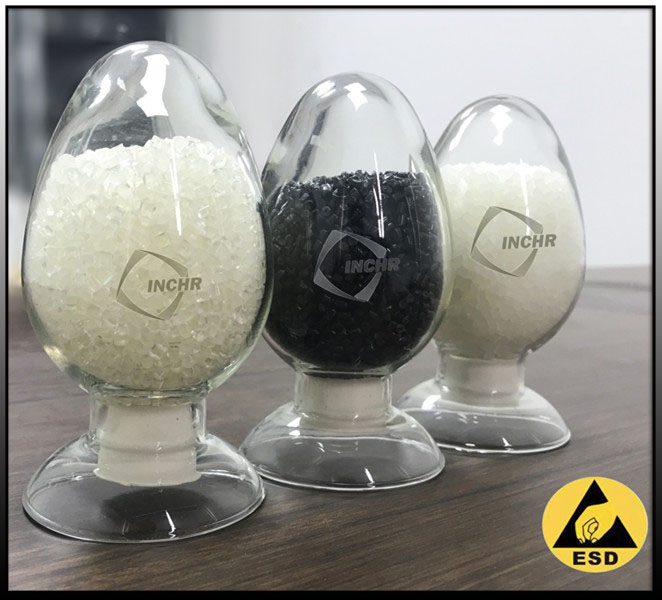
Manufacturers classify ESD plastics by mechanism and resistivity level. INCHR produces a complete family that covers every category:
- Permanent antistatic compounds: use ionic additives that migrate to the surface and attract a thin moisture layer, typically providing static-dissipative performance around 10⁹ ohm/sq. Ideal for packaging and consumer electronics enclosures.
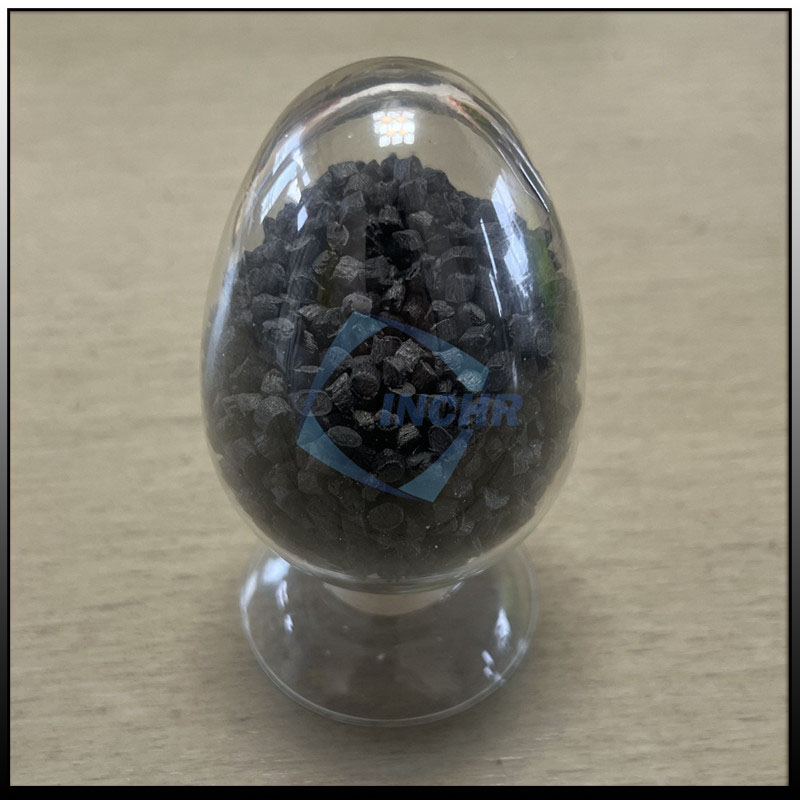
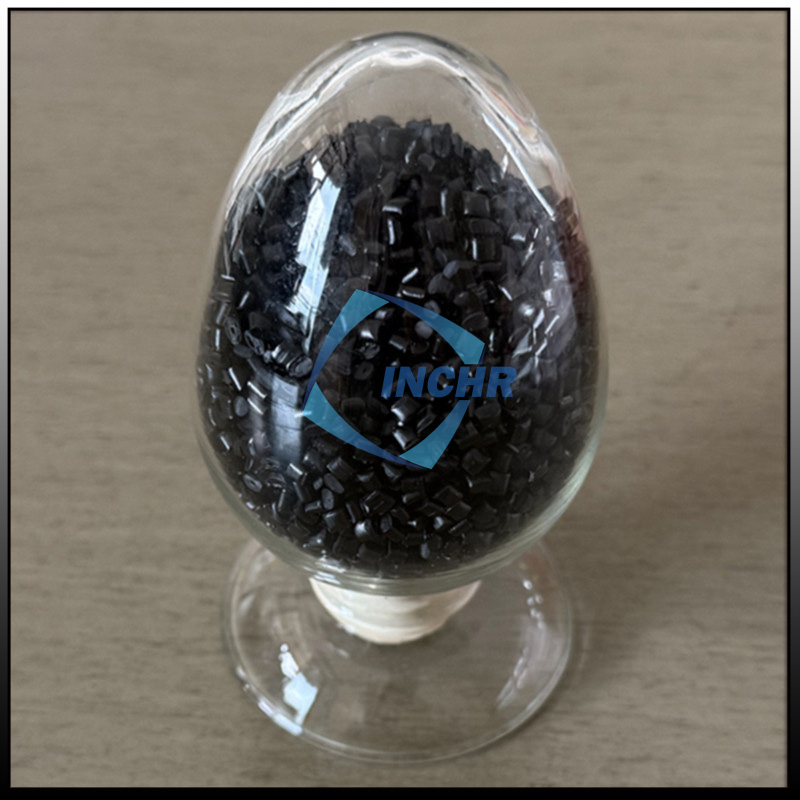
- Conductive compounds and ESD masterbatches: rely on carbon black networks formed during melt compounding, reaching conductive levels between 10³ and 10⁶ ohm/sq. Performance is independent of ambient humidity.
- Carbon fiber reinforced compounds: combine structural strength with permanent conductivity, widely used in automotive fuel systems and industrial parts that must survive mechanical load.
- Graphene-reinforced plastics: use graphene nanoplatelets to achieve high conductivity with very low filler loading, preserving lightweight and mechanical properties.
How ESD Plastics Work
The conductive function depends on a percolation network. When carbon black or graphene particles are evenly dispersed in the polymer matrix and reach a critical concentration, they touch one another and form continuous pathways for electrons to travel. A charge arriving at the surface is transported along these pathways to ground instead of remaining concentrated at one point.
Two parameters matter during qualification: surface resistivity, measured in ohm/sq, and volume resistivity, measured in ohm·cm. Both must be tested per accepted industry methods such as IEC 61340 or ASTM D257. Because twin-screw compounding disperses fillers more evenly than single-pass mixing, the dispersion quality directly determines whether the part will hit its target resistivity batch after batch.
Key Applications of ESD Plastics
ESD plastics protect quality in every environment where static charge threatens products or safety:
- Electronics manufacturing: IC trays, carrier tapes, tote boxes, and workstation fixtures that shield sensitive components from discharge
- Semiconductor clean rooms: wafer cassettes, storage racks, and equipment housings with controlled charge dissipation
- Electronic packaging: antistatic bags, film, trays, and foam for shipping ESD-sensitive goods
- Automotive: fuel filler necks, fuel tanks, and connectors where accumulated charge near flammable liquid is a fire risk
- Industrial and chemical: hoses, rollers, conveyor components, and containers for dusty or solvent-rich environments
ESD Plastics vs. Temporary Static-Control Solutions
Surface coatings, antistatic sprays, and conductive tape work until they wear off. Ionizing blowers require power, maintenance, and regular calibration. By comparison, ESD plastics keep working for the life of the part, require zero ongoing effort, and add no visible cost to the production floor. The trade-off is straightforward: temporary solutions suit short-term or low-volume needs, while molded-in ESD plastics become the economical choice once volume grows and reliability is non-negotiable.
How to Choose the Right ESD Plastics
Start by defining the resistivity target for your application: a protective film may only need 10⁹ ohm/sq, while an EMI shielding enclosure may require 10³. Next, match the carrier resin to your base polymer and process, whether injection molding, extrusion, or blow molding, so mechanical properties remain intact. Then confirm dispersion quality and testing documentation, because consistency is what separates a reliable ESD material from a lottery ticket. Finally, request samples and run resistivity testing on your own line before scaling to production.
Why Choose INCHR for ESD Plastics?
INCHR was established in Dongguan, China, in 2012, and has grown into a professional ESD plastics manufacturer. Our product range covers permanent antistatic additives, antistatic compounds, conductive compounds, ESD masterbatches, carbon fiber reinforced compounds, and graphene-reinforced plastics, so customers can source the entire static-control portfolio from a single supplier.
Our R&D team works in partnership with East China University of Science and Technology, combining academic research with production reality. On the factory floor, advanced polymerization equipment, twin-screw granulation units, and a single-screw dyeing workshop produce uniform compounds, while professional ESD testing equipment verifies every batch before shipment. The whole system operates under ISO9001:2008 quality certification, giving customers documented, audited consistency.
Conclusion
ESD plastics have moved from a specialty product to the default choice in electronics, packaging, automotive, and industrial applications where static control determines quality and safety. By understanding the material types, the percolation mechanism, and the selection criteria, engineers can specify the right grade with confidence. With a full product family, certified quality, and more than a decade of ESD compounding experience, INCHR is ready to help you build static control directly into your next product.